Every day, people discard large quantities of food waste, agricultural residue, animal manure, and other biodegradable materials without realizing their true value.
When poorly managed, this organic waste can create unpleasant odours, attract pests, contaminate surroundings, and release greenhouse gases.
A Chem Process Systems Pvt. Ltd. offers a smarter solution. It converts organic waste into clean, usable energy while supporting responsible waste management and a circular economy.
Instead of treating waste as a burden, businesses, farms, municipalities, and industries can use it as a renewable resource.
Our registered office is located in Sanand, Gujarat, India.
From Waste Burden to Renewable Energy Resource
Organic waste contains biodegradable matter that can naturally produce biogas under controlled conditions. A CBG plant captures this energy and processes it into a cleaner fuel suitable for various applications.
Common feedstocks used in compressed biogas production include:
• Food and kitchen waste
• Cattle dung and animal manure
• Agricultural residue
• Fruit and vegetable waste
• Press mud from sugar industries
• Sewage and organic sludge
• Industrial biodegradable waste
Using locally available feedstock can reduce waste transportation requirements and support decentralized energy production.
It also creates an opportunity to recover value from materials that might otherwise end up in dumping grounds or remain unmanaged.
What Is a Compressed Biogas Plant?
A Compressed Biogas plant converts biodegradable waste into purified and compressed biogas.
The organic material first undergoes anaerobic digestion, a biological process in which microorganisms break down waste in an oxygen-free environment.
This process produces raw biogas containing methane, carbon dioxide, moisture, and small amounts of other impurities.
A Compressed Biogas plant converts biodegradable waste into purified and compressed biogas.
The resulting Compressed Biogas can serve as a renewable energy source for suitable transport, industrial, commercial, and thermal applications.
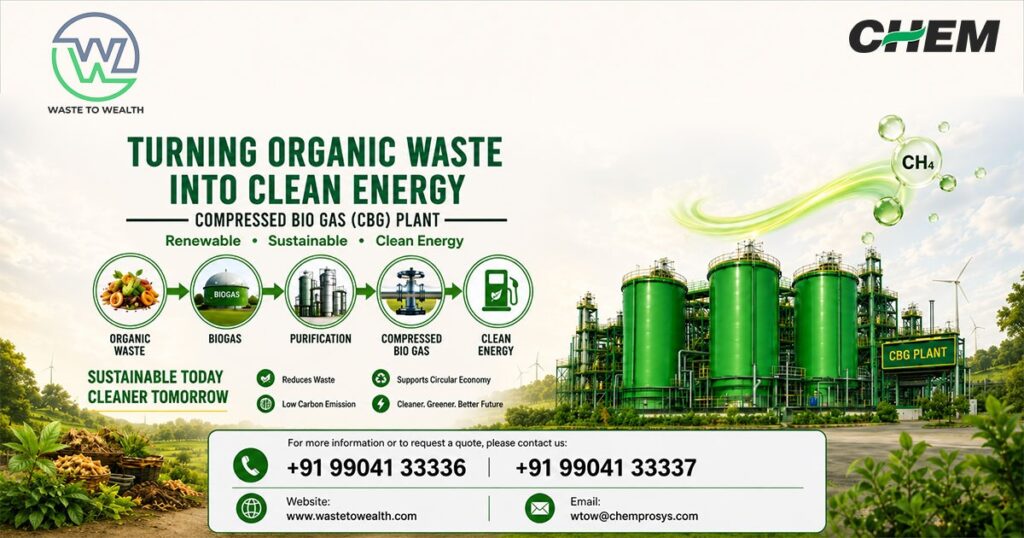
The Clean-Energy Journey: From Organic Waste to CBG
The conversion of organic waste into compressed biogas takes place through a carefully managed series of stages.
- Organic Waste Collection and Preparation
The process begins with the collection of biodegradable feedstock. Operators remove unwanted materials such as plastics, metals, stones, and other contaminants. - Operators may then shred, mix, or convert the waste into a uniform slurry.Proper feedstock preparation supports stable digestion and efficient plant performance.
- Anaerobic Digestion
The prepared material enters a sealed digester where microorganisms break it down without oxygen. Under controlled temperature and operating conditions, the organic matter releases biogas.
This stage is central to the plant because consistent biological activity directly affects gas production. - Biogas Collection
The closed system collects the raw biogas produced inside the digester. At this stage, it generally contains methane along with carbon dioxide, water vapour, hydrogen sulphide, and other trace components. - Biogas Purification
Operators must upgrade raw biogas before it becomes a higher-quality energy product. - The purification system removes moisture, carbon dioxide, hydrogen sulphide, and other unwanted components according to the plant’s process requirements.
Purification improves the methane content and overall usability of the gas. - Compression and Storage
After purification, specialized equipment compresses the upgraded gas. Operators can then store the Compressed Biogas in appropriate cylinders, cascades, or storage systems for controlled distribution and use. - Clean Energy Utilization
Users can use the finished CBG wherever its quality and technical specifications meet the requirements of the intended application.It provides organizations with an alternative energy pathway based on renewable organic resources.
Why Compressed Biogas Is More Than an Alternative Fuel
CBG production connects waste management, renewable energy, and resource recovery within one integrated system. Its value extends beyond the gas produced by the plant.
Reduces Organic Waste
A CBG plant processes biodegradable waste in a controlled environment. This can reduce the quantity of organic material sent to open dumping areas or conventional disposal facilities.
Supports Lower-Carbon Energy
Because CBG comes from renewable organic material, it can reduce dependence on conventional fossil fuels. Capturing and using biogas can also prevent methane from escaping uncontrolled during waste decomposition.
Advances the Circular Economy
Compressed biogas plants demonstrate a practical circular model: organic waste becomes energy, while the remaining digestate may be processed for suitable agricultural or soil-related uses, subject to quality and regulatory requirements.
Encourages Local Energy Production
Feedstock can often be sourced from farms, food-processing facilities, markets, dairies, municipalities, and other nearby generators. This creates opportunities for localized waste processing and energy generation.
Improves Waste Management Practices
Structured collection, segregation, and treatment of organic waste can contribute to cleaner premises and more responsible environmental management.
The Often-Overlooked Value of Digestate
Energy is not the only useful output of anaerobic digestion. Once the digestion process is complete, a nutrient-containing material known as digestate remains.
Depending on its composition, treatment, quality, and applicable regulations, digestate may be processed into organic manure or soil-conditioning products. This creates an additional resource-recovery opportunity and can return nutrients to agricultural land.
Testing and proper processing are essential before digestate is used or marketed.
Who Can Benefit from a CBG Plant?
Compressed biogas projects can be developed for different capacities and feedstock conditions. They
may be relevant for:
• Municipal bodies managing organic solid waste
• Dairy farms and cattle shelters
• Agricultural cooperatives
• Food-processing industries
• Sugar mills and distilleries
• Hotels, institutions, and large commercial kitchens
• Fruit and vegetable markets
• Industrial facilities generating biodegradable waste
• Waste-management and renewable-energy businesses
The right solution depends on the type and daily quantity of feedstock, methane potential, available land, local climate, gas demand, logistics, operating capability, and regulatory requirements.
What Makes a CBG Project Successful?
Installing equipment alone does not guarantee long-term results. A reliable compressed biogas project begins with detailed technical and commercial planning.
Important considerations include:
Consistent Feedstock Availability
The plant requires a dependable quantity and quality of organic waste. Seasonal changes, contamination, moisture levels, and transportation distances should be evaluated before finalizing the project.
Suitable Plant Capacity
An oversized plant may remain underutilized, while an undersized system may not process the available waste efficiently. Capacity should be determined through a realistic feedstock assessment.
Effective Gas Purification
A well-designed purification system is required to remove unwanted components and achieve the target gas quality.
Safe Compression and Storage
Compression systems, pipelines, valves, instruments, and storage arrangements must be designed around applicable engineering and safety requirements.
Skilled Operation and Maintenance
Operators need appropriate training to monitor digestion, gas production, purification performance, safety parameters, and routine maintenance.
Product Utilization or Offtake Planning
Before commissioning the plant, project owners should identify how the produced gas and digestate will be used, transported, or sold.
Chem Process Systems Pvt. Ltd. provides CBG plant solutions designed around specific project requirements.
Connect with the team to discuss your feedstock availability, desired plant capacity, technical needs, or quotation requirements.
Contact: +91 99041 33336 | +91 99041 33337
Website: www.wastetowealth.com
Email: wtow@chemprosys.com